 ®
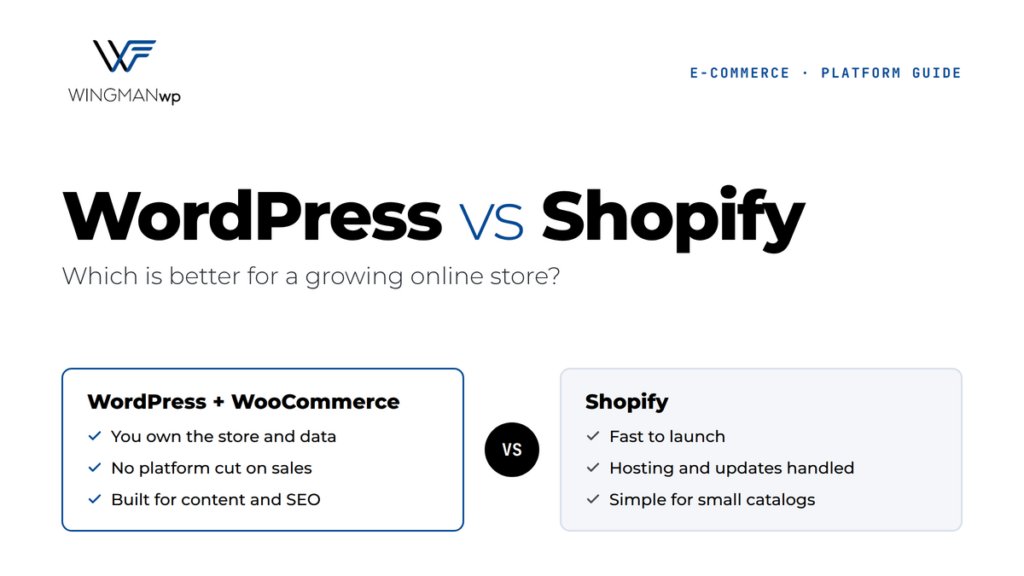
WordPress vs Shopify is one of the most common questions online store owners ask, especially once a store starts growing and the platform choice begins to affect costs, marketing and day-to-day work. Both are excellent platforms. They’re just built for different kinds of businesses.
In this WordPress vs Shopify comparison, “WordPress” means a self-hosted WordPress site running WooCommerce, the free e-commerce plugin that turns WordPress into a full online store.
WordPress vs Shopify: the quick answer
Choose Shopify if you want to launch fast, sell a straightforward product range, and never think about hosting, updates or security.
Choose WordPress with WooCommerce if you want full ownership of your store, plan to grow through content and SEO, need custom features or integrations, or want to avoid paying extra platform fees on every sale as you scale.
Cost: subscription vs ownership
Shopify charges a monthly subscription, which starts at around $39 a month for the Basic plan (less if billed annually), according to Shopify’s pricing page, plus payment processing on every sale. If you use a payment provider other than Shopify Payments, such as PayPal or Stripe, Shopify adds its own extra fee on top: 2% on Basic, 1% on Grow, 0.6% on Advanced and 0.2% on Plus. Most stores also pay for several apps each month.
WooCommerce itself is free. You pay for hosting, any premium extensions you need, and someone to maintain the site. You still pay normal payment processing fees, but WordPress never adds a platform cut on your sales. For a growing store, that difference adds up: on $20,000 a month in sales through a third-party gateway on Shopify Basic, the extra fee alone is $400 a month.
Control and flexibility
Shopify is a closed, hosted platform. That keeps things simple, but you work within its rules: its checkout, its app store, its limits on how far you can customize.
WordPress is open source. You own the code, the data and the customer list, and you can build almost anything: custom product configurators, B2B pricing, memberships, subscriptions, bookings, or deep integrations with your CRM and ERP. You can also move hosts any time without rebuilding your store.
Content and SEO
In the WordPress vs Shopify debate, this is where WordPress has its biggest edge. It started as a publishing platform, so blogs, guides, landing pages and SEO tools are built into how it works. If your growth plan depends on ranking in Google and attracting customers with helpful content, WordPress gives you more control over every page, URL and piece of structured data.
Shopify handles the SEO basics well and has a built-in blog, but it’s a store first and a content platform second.
Maintenance and security
This is Shopify’s biggest strength. Hosting, security, updates and uptime are all handled for you.
With WordPress, those jobs are yours (or your partner’s). Plugins, themes, WordPress core and PHP all need regular, careful updates, and as recent security news has shown, skipping them is risky. Done properly, a WordPress store is just as stable and secure. But it does need someone looking after it.
WordPress vs Shopify: which should you choose?
Shopify is usually the better fit if:
- You’re just starting out and want to sell quickly.
- Your product range and checkout are simple.
- You don’t have anyone to handle technical maintenance.
WordPress with WooCommerce is usually the better fit if:
- Your store is growing and platform fees are starting to hurt.
- Content and SEO are a big part of how you win customers.
- You need custom features, B2B pricing or integrations with other systems.
- You want to own your store and data outright, with no platform lock-in.
Can you switch platforms later?
Yes, and many growing stores do. Moving from Shopify to WordPress is common once fees, app costs or customization limits start holding a business back. Products, customers and order history can all be migrated, but a careful move also protects your SEO: every old product and page URL needs a redirect to its new address, or you risk losing the Google rankings you’ve built. That’s why the WordPress vs Shopify decision is worth getting right early, and why any switch should be planned, tested on staging and launched with redirects in place from day one.
The catch with WordPress (and how we solve it)
When store owners weigh WordPress vs Shopify, the main reason they hesitate on WordPress is the upkeep. That’s exactly the gap WingmanWP fills. We handle the updates, security, backups, performance and monitoring, so you get the freedom and cost savings of WordPress with the peace of mind people usually associate with Shopify.
Not sure which platform is right for your store? Talk to WingmanWP and we’ll give you an honest recommendation, even if the answer is Shopify.
Shopify pricing and fees are based on Shopify’s published 2026 plans and may change. Check Shopify’s pricing page for current figures, and WooCommerce.com for WooCommerce extensions.
Is WordPress cheaper than Shopify?
Often, especially as a store grows. WooCommerce is free and WordPress never takes a cut of your sales, while Shopify charges a monthly plan plus extra fees if you use a third-party payment provider. However, WordPress has its own costs for hosting, premium extensions and maintenance, so compare the total yearly cost, not just the monthly price.
Is WooCommerce really free?
The WooCommerce plugin itself is free. You’ll still pay for hosting and a domain, and possibly for premium extensions such as subscriptions, bookings or advanced shipping.
Which is easier for beginners?
Shopify. You can set up a store in an afternoon without any technical knowledge. WordPress takes more setup, but offers far more flexibility once it’s built.
Can I move from Shopify to WordPress without losing my rankings?
Yes, if the migration is planned properly. Your products, customers and orders can be moved over, and redirects from old URLs to new ones protect the search rankings you’ve already earned.
WordPress vs Shopify: which is better for large stores?
Both can handle large stores. Shopify scales through its higher plans, including Shopify Plus, while WordPress with WooCommerce scales with good hosting and a solid technical setup. The right choice depends on how much customization, control and content your business needs.
 Ayesha UmarWritten by